
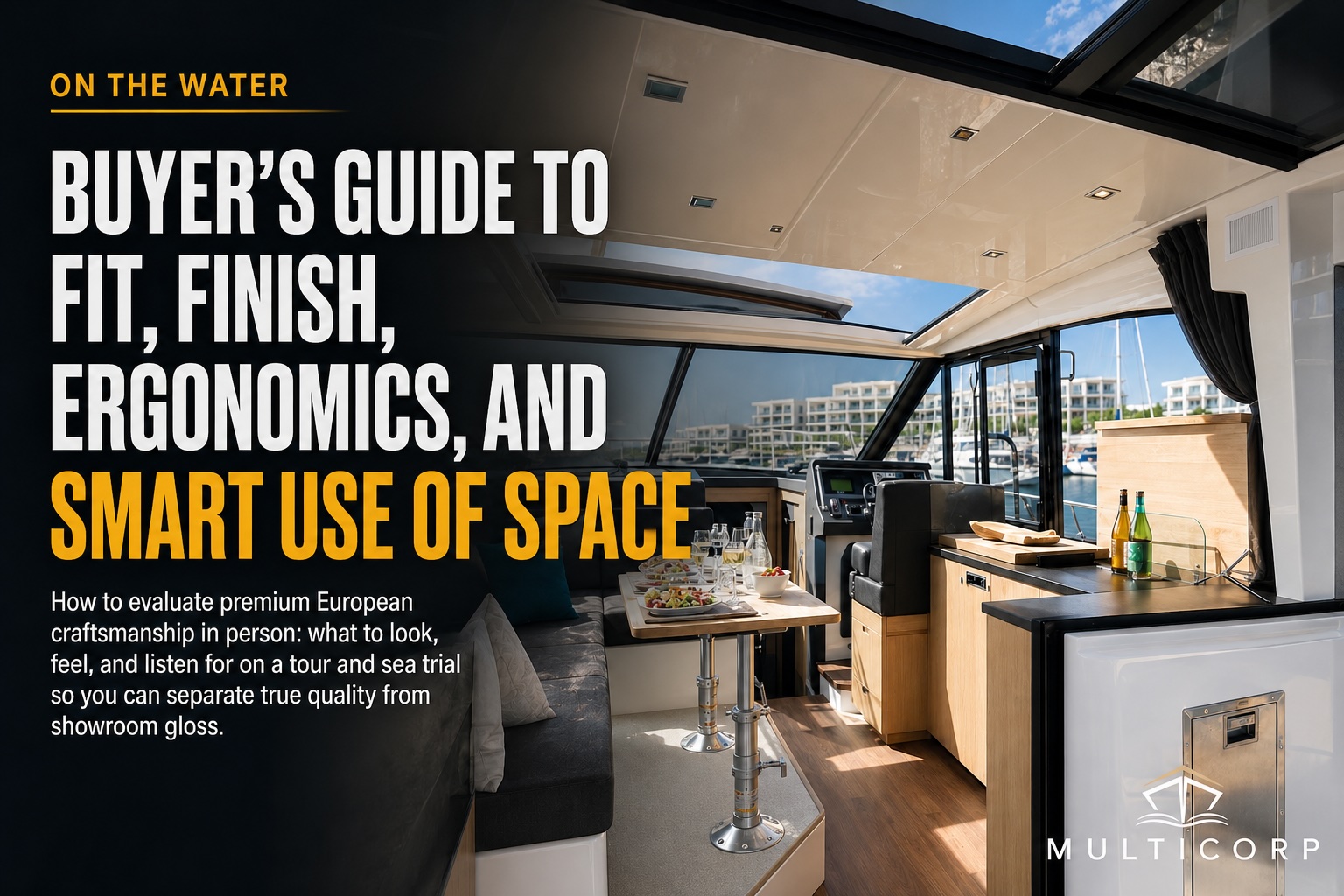
How To Evaluate Premium European Craftsmanship In Person
A Buyer’s Guide To Fit, Finish, Ergonomics, and Smart Use of Space
When you step aboard a premium European boat, the real story isn’t in the brochure—it’s in what you see, touch, and feel during your tour and sea trial. High-gloss gelcoat and mood lighting are easy. True craftsmanship shows up in the details that hold up after years of Chesapeake Bay chop, Great Lakes swell, inland lake weekends, and coastal runs from Maryland to Michigan to Texas.
This guide walks you through how to evaluate a boat like a serious owner, not a casual shopper—using Skamander by Parker Poland as a benchmark for thoughtful European design, strong construction, and efficient outboard-powered performance.
1. First Impressions: What Quality Looks And Feels Like
Before anyone starts talking horsepower or electronics, pause at the dock and take a quiet look.
Exterior lines and finish
- Sight down the hull sides: Are the lines straight, fair, and consistent, or do you see waves and ripples in the gelcoat?
- Inspect the gelcoat: Is the color depth even? Are there visible sanding marks, orange peel, or overspray around fittings?
- Look at seams and joints: Rub rail seams, hull-to-deck joints, and window frames should be uniform and tight, with no gaps or messy sealant.
Rails, cleats, and hardware
- Grab the bow rails and side rails: Do they flex or feel rock solid? A premium builder will use substantial bases and backing plates.
- Tug on cleats and fairleads: They should feel integrated into the structure, not just screwed into thin fiberglass.
- Check hardware alignment: Hinges, latches, and hatches should sit straight and flush.
European builders like Parker Poland pay close attention to these fundamentals. It’s where long-term durability starts.
2. Fit And Finish: Look Under, Behind, And Inside
Quality boats are finished where many buyers never look. That’s where you separate true craftsmanship from showroom gloss.
Hatches and doors
Open every hatch, door, and locker:
- Feel the hinges: Are they stainless, properly sized, and through-bolted, or are they light-duty and screwed into thin material?
- Test the operation: Doors and hatches should open and close smoothly without binding, rattling, or needing to be slammed.
- Check edges and undersides: Are cutouts smooth and finished, or rough and splintered? Premium builders finish hidden areas.
Lockers, bilge, and service spaces
- Look inside lockers: Are they lined, drained, and cleanly molded, or just raw fiberglass?
- Peek into the bilge and under decks: Well-run wiring, neatly labeled hoses, and secure clamps are signs of professional build quality.
- Check fasteners and brackets: Corrosion-resistant metals, double clamps on critical hoses, and proper supports tell you the builder expects the boat to live in real-world conditions—saltwater in the Chesapeake Bay, freshwater in the Great Lakes, and everything in between.
3. Ergonomics: How The Boat Fits Real People, All Day
European pilothouse boats, family cruisers, and day boats often shine in ergonomics—if you know how to evaluate them.
At The Helm
Sit or stand at the helm as if you were running from Baltimore to Annapolis or across Lake Michigan:
- Sightlines: Can you see forward, aft, and to both quarters without stretching or crouching? How is visibility when seated versus standing?
- Controls: Are the throttle, wheel, trim tabs, and bow thruster (if equipped) in natural reach, or do you have to twist and lean?
- Footing: Is there a proper footrest? Can different-height drivers stand comfortably without fatigue?
- Seating: Does the helm seat offer bolstering, flip-up bolsters, and support for long runs?
Skamander by Parker Poland designs helm stations with real-world cruising in mind—think long weekends on the Chesapeake, not just a quick loop around the marina.
For Crew And Guests
Move through the boat as though you’re hosting family or fishing with friends:
- Side decks and walkways: Are they wide enough to move safely while carrying gear or a fender? Handholds where you naturally reach?
- Seating angles and backrests: Sit in every seating position. Do you feel supported, or are you sliding forward?
- Boarding and dock access: How easy is it to board from a floating dock, fixed pier, or swim platform? Are grab handles where they should be?
If you feel comfortable, secure, and relaxed moving around at the dock, you’ll appreciate it even more when conditions get lumpy.
4. Smart Use of Space: Living With The Boat, Not Just Touring It
On a premium outboard-powered boat, space and layout are everything—whether you’re coastal cruising, fishing, or enjoying inland lakes.
Modular and convertible spaces
Look for layouts that change with your day:
- Dinettes that convert to sunpads or berths without wrestling with heavy cushions.
- Cockpit benches that fold away to create fishing or watersports space.
- Flexible tables that adjust for dining, lounging, or stowing.
Ask yourself: Could this boat handle a Friday evening cruise on the Severn River, a Saturday of watersports on a Pennsylvania lake, and a Sunday of fishing off the New Jersey coast without feeling compromised?
Storage that actually works
- Open every locker: Is storage deep, wide, and shaped for real gear (rods, fenders, skis, lifejackets), not just a few small bags?
- Dedicated spots: Is there a purposeful place for the anchor, dock lines, cooler, and safety gear?
- Cabin practicality: On family cruisers and weekenders, is there room to store bedding, bags, and kids’ gear without clutter?
Skamander’s European layouts are known for packing a lot of function into a manageable footprint—something you’ll appreciate whether you slip in Annapolis or trailer to inland lakes.
5. On The Sea Trial: What To Feel, Hear, And Notice
A sea trial is more than “Does it feel fast?” Use it to evaluate the engineering you can’t see.
Ride and handling
- Acceleration and planing: Does the boat climb onto plane smoothly without struggling or porpoising?
- Trimmed running attitude: Does it feel balanced at different speeds, or constantly need adjustment?
- Turns: In moderate S-turns and tighter maneuvers, does the hull feel predictable and secure, or does it slide and lean awkwardly?
Skamander by Parker Poland hulls are engineered for efficient, confident running with modern outboards—especially important on bigger inland lakes and open-bay runs.
Noise, vibration, and solidity
- Listen at cruise: Are there rattles from doors, hatches, or hardtop structures? A quiet, solid boat speaks volumes about fit and construction.
- Feel the deck and structure: Any flex underfoot when you move? Do bulkheads and cabinetry creak, or feel like part of a solid whole?
- Cabin noise: On pilothouse and cabin models, does the structure insulate you from wind and engine noise, or is it loud and tiring?
These are the differences you’ll appreciate after hours on the Chesapeake Bay or running across a breezy inland reservoir.
6. Evaluating Long‑Term Ownership, Not Just The Boat
Premium European boats are an investment. The builder and your ownership partner should support you well beyond closing.
Ask pointed questions:
- Service access: Can key components be reached for routine service and potential repairs without tearing the boat apart?
- Systems documentation: Are wiring, plumbing, and equipment properly documented and labeled?
- Support and coordination: Who helps you navigate warranty issues, maintenance schedules, and seasonal needs?
MultiCorp Marine’s Command365 program was created specifically to answer these questions for serious owners—providing year-round service coordination, maintenance guidance, dockside support, and warranty assistance so you spend more time boating and less time chasing answers.
7. Bringing It All Together
When you evaluate a premium European boat in person:
- Look beyond the shine to the structure and finishing.
- Sit, stand, and move as if you truly owned the boat.
- Test the layout against how you actually boat—Chesapeake cruising, Great Lakes weekends, inland lake watersports, or coastal fishing.
- Use the sea trial to listen for quality and feel for engineering.
- Consider the ownership experience and who will stand beside you long term.
If you’d like guidance walking through these steps on a Skamander by Parker Poland—or want a knowledgeable second set of eyes on your next boat—MultiCorp Marine is here as your ownership partner, not just your dealer.
Contact MultiCorp Marine today to schedule a personalized consultation or on‑water evaluation and discover what true premium craftsmanship feels like in real-world boating.