
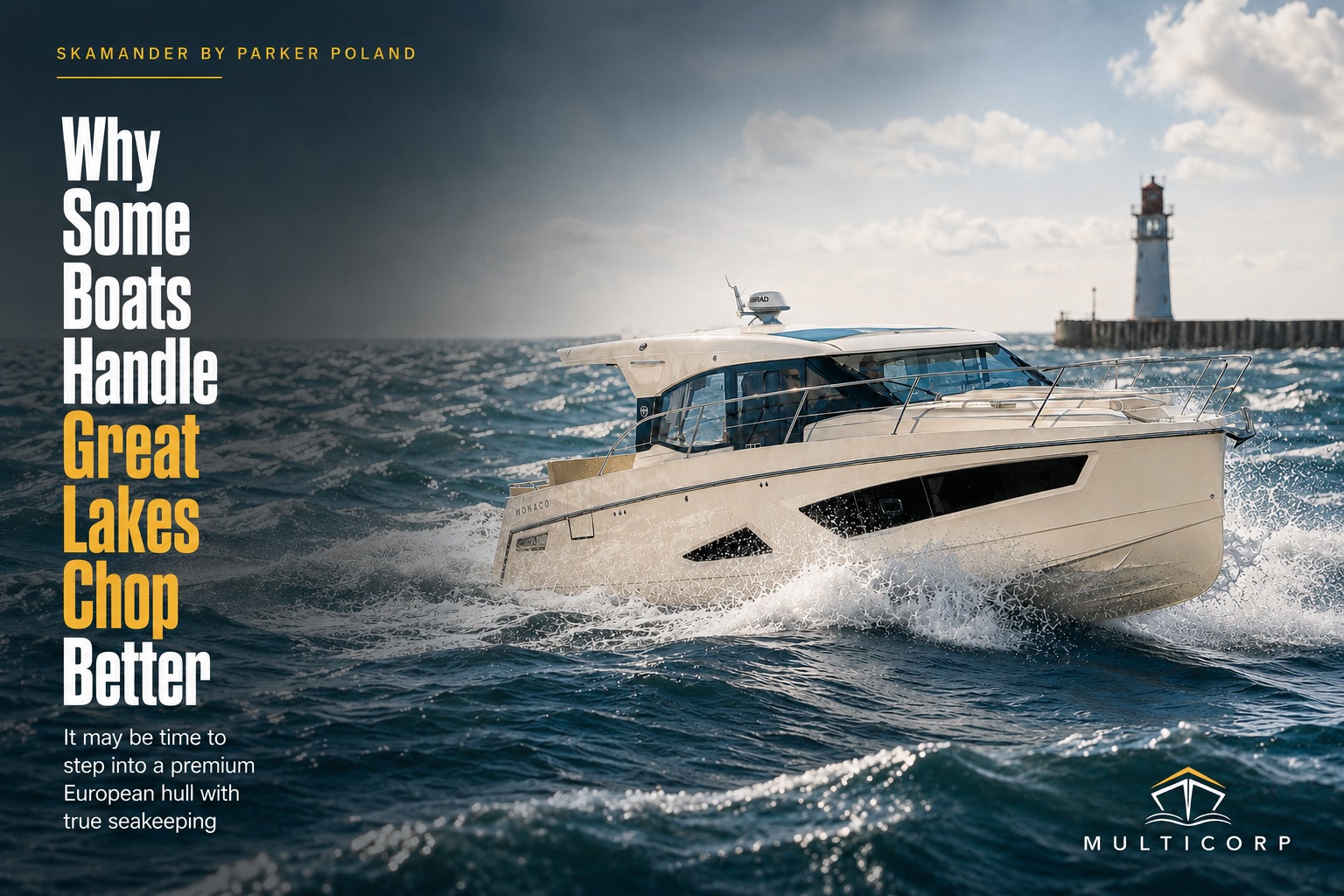
Why European Seakeeping Matters in Great Lakes Chop
If you boat on Lake Michigan, Erie, or Huron, you already know the truth: Great Lakes chop can feel more punishing than many coastal runs. Short, steep waves, fast-building squalls, confused seas off breakwalls and river mouths—days like that expose the difference between an average hull and a truly capable one.
This is where European seakeeping—and brands like Skamander by Parker Poland—really matter. Thoughtful hull design, intelligent weight distribution, and true pilothouse protection translate directly into comfort, range, and crew confidence on days when lesser boats stay tied up.
At MultiCorp Marine, we see this every season with owners who boat the Great Lakes, Chesapeake Bay, and inland lakes across the U.S. The conditions change, but the fundamentals of seakeeping do not.
The Problem: Short, Steep Great Lakes Waves
Unlike long-period ocean swells, Great Lakes waves often:
- Build quickly with wind shifts and frontal passages
- Stack up short and steep in 2–4 footers that feel like a washing machine
- Turn confused around harbor entrances, shoals, and shipping channels
- Combine with cold water and wind to make exposure a real safety factor
Many North American “fair-weather” designs are optimized for calm or lightly choppy lakes: lots of beam, tall topsides, big open cockpits, and light structure. They look great at the dock and feel roomy on summer days—but when the breeze kicks up, they pound, slam, and ask you to slow down long before you’re ready to head back.
European builders like Skamander by Parker Poland start from a different brief: boats must work in rugged Baltic, North Sea, and Mediterranean conditions, not just on postcard afternoons. That difference shows up the moment the lake turns ugly.
Hull Design: Cutting Through Chop vs. Riding On Top
Most buyers can see a sharp bow, but seakeeping is about the whole running surface. Key elements of European hull design that pay off in Great Lakes chop include:
Deeper, Well-Carried V
Many Skamander models use:
- A deep forefoot to cut into steep head seas rather than ride over them
- A moderately deep-V midsection to soften landings and resist pounding
- Refined strakes and chines to add lift without creating harsh impacts
In practical terms, that means you can keep a safe, efficient cruise speed when the wind is 15–20 knots and the waves get close together. Instead of slamming and rattling the crew, the hull slices, then lands predictably, reducing fatigue and strain.
Designed for Real-World Loading
European engineering also assumes:
- Full fuel and water
- Crew, gear, and provisions
- Weather that may deteriorate mid-trip
Hull forms, deadrise, and running attitudes are tuned for loaded operation—not just brochure conditions. For Great Lakes owners who regularly carry family, fishing gear, or overnight equipment, that matters. The boat stays planted and predictable when other designs become bow-light and twitchy.
Weight Distribution: Stability, Comfort, and Control
Where and how weight is placed is just as important as how much weight there is. On a premium European boat:
- Fuel tanks are usually centralized and low in the hull, avoiding big trim changes as you burn fuel.
- Batteries and systems are tucked low and near the center of gravity for a solid, “on rails” feel.
- Structural reinforcements and laminates add mass where it improves ride quality without making the boat sluggish.
For Great Lakes chop, that thoughtful weight distribution delivers three tangible benefits:
-
Gentler motion
A slightly heavier, well-balanced hull tends to shoulder through short waves rather than slap across their tops. Your crew feels like they’re riding in the boat, not on top of it. -
Consistent trim and handling
As the lake builds or you move people around the boat, the running attitude doesn’t change dramatically. That translates to better visibility, more predictable steering, and less need for constant trim adjustments. -
More usable speed window
When a boat feels stable and planted, you can choose the speed that best suits the conditions, rather than being forced to crawl simply because the hull is misbehaving.
For owners running long distances on Lake Michigan, crossing from Ohio to Ontario on Lake Erie, or jumping between ports on Lake Huron, that usable speed window turns into real-world range and flexibility.
Pilothouse Protection: Comfort and Confidence in Real Weather
In Great Lakes boating, exposure is often the limiting factor—not just hull shape. Wind-driven spray at 25–30 knots over cold water can turn a pleasant run into survival mode in minutes.
This is where pilothouse boats and enclosed family cruisers from Skamander by Parker Poland really shine:
- Full-height windshields and rigid roofs shield you from spray and wind chill.
- Sliding doors and aft enclosures let you dial in ventilation on hot days and seal up quickly when a squall line approaches.
- Thoughtful heating and defog systems (where equipped) maintain visibility and comfort in shoulder seasons.
Instead of worrying whether your crew is freezing on the bow or in a soaked cockpit, you’re all protected, warm, and focused on navigation. That changes your boating calendar:
- Extend your Great Lakes season into April, May, and late October.
- Run comfortably on marginal days when open boats are confined to the marina.
- Make longer coastal-style passages on big inland waters with fewer weather compromises.
And because many Skamander models combine pilothouse security with open cockpit space, you don’t sacrifice the summer lake lifestyle—you simply gain more days when the boat is actually usable.
Why This Matters for Range and Real-World Enjoyment
When you pair a European hull form and balanced weight distribution with an efficient, outboard-powered platform, you unlock:
- Better fuel efficiency at realistic Great Lakes cruising speeds
- Longer effective range because you can maintain speed in moderate chop
- Less fatigue for the captain and crew, leading to more time on the water
- Higher confidence bringing family, friends, or clients aboard even when the forecast is marginal
Many of our customers in the Chesapeake Bay, Mid-Atlantic, Great Lakes, Texas, and Florida tell us the same thing: they didn’t realize how limiting their old boat was until they moved into a premium European design engineered for serious water.
MultiCorp Marine: A Partner for Premium Great Lakes Ownership
At MultiCorp Marine, we don’t just sell boats—we help owners plan for the entire ownership experience:
- Matching you with the right Skamander by Parker Poland model for your home waters and boating style
- Configuring layouts, power, and options for Great Lakes chop, inland lakes, or coastal runs
- Supporting delivery logistics and commissioning, no matter whether you’re in Michigan, Ohio, Pennsylvania, New York, Maryland, Virginia, or beyond
Through our Command365 program, qualifying owners also gain:
- Year-round service coordination and maintenance guidance
- Warranty assistance and dockside support
- Proactive help designed to reduce downtime and keep you confident in your boat’s readiness
That owner-focused approach comes directly from our own real-world boating and refit experience. We understand that seakeeping is only valuable if your boat is ready to go when the lake finally lays down—or when you decide to push out despite the forecast.
Ready to Rethink What’s Possible on the Great Lakes?
If you’re tired of canceling trips because your boat can’t handle Lake Michigan afternoons, Erie afternoons storms, or Huron crossings, it may be time to step into a premium European hull with true seakeeping.
Explore what Skamander by Parker Poland and MultiCorp Marine can do for your Great Lakes and inland lake boating. Contact us today to discuss your boating style, your home waters, and how we can help you enjoy more confident days on the water—with less stress and more comfort for everyone on board.