
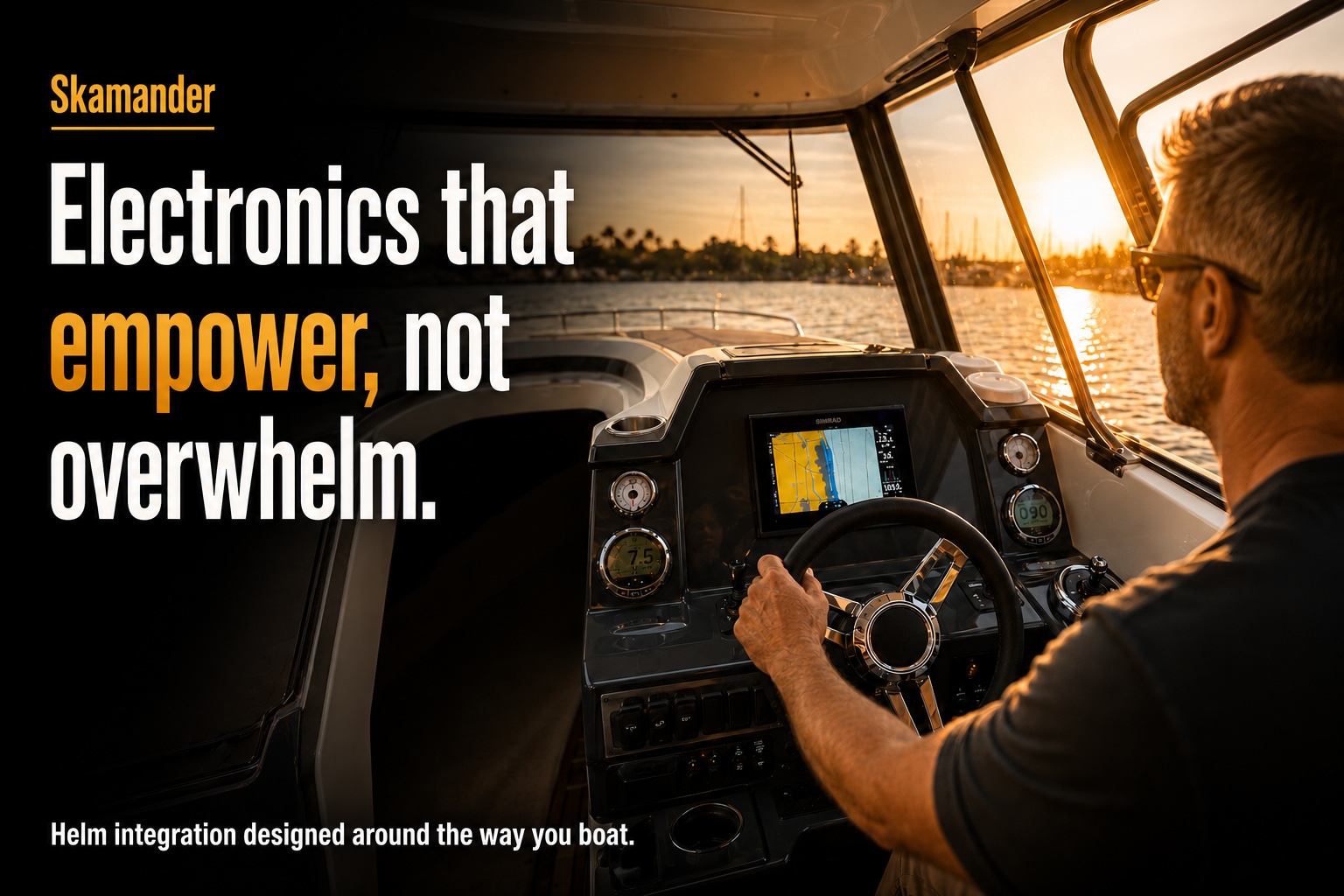
Electronics That Empower, Not Overwhelm: A Practical Guide to Helm Integration for Modern Outboard Cruisers
Modern outboard-powered cruisers—like the pilothouse boats, family cruisers, and weekenders from Skamander by Parker Poland—are capable of incredible things. Chartplotters, radar, autopilot, cameras, digital switching, and advanced engine data can all work together to make boating safer, easier, and more enjoyable.
But if you’ve ever stepped aboard a boat where the helm looks like an airplane cockpit, you know technology can also feel intimidating.
At MultiCorp Marine, we approach electronics the same way we approach premium boat ownership: focus on what genuinely improves your time on the water, keep it intuitive, and make sure it stays serviceable for the long term. Below is a practical guide to building a helm that empowers you—without overwhelming you.
Start with How You Actually Boat
Before choosing screen sizes or radar ranges, clarify how and where you use your boat:
- Chesapeake Bay or coastal cruising (Baltimore, Annapolis, New Jersey shore, Virginia tidewater, Florida coasts): Think navigation, shallow-water awareness, and weather.
- Great Lakes boating (Michigan, Erie, Ontario, Huron): Focus on long-range visibility, changing weather, and nighttime capability.
- Inland lakes and rivers (Pennsylvania, Texas, inland Mid-Atlantic, Southeast lakes): Emphasize ease of use, fishing features (if applicable), and simple power management.
Key questions:
- How often do you run at night or in limited visibility?
- How far do you typically cruise in a day?
- Are you primarily cruising, fishing, entertaining, or doing a bit of everything?
- Who else will run the boat—spouse, kids, friends?
Your answers determine which electronics are “must-haves” versus “nice-to-haves,” and help avoid buying a complicated system you’ll never use.
Choosing Screen Sizes: Bigger Isn’t Always Better
Large glass bridge displays look impressive, but the best helm is the one you can read and operate confidently in real conditions.
Practical guidelines
-
Single 9”–12” display
Ideal for:- Smaller pilothouse and day cruisers
- Inland and nearshore use
- Owners who prefer a simple setup
You’ll typically run one main page (chart + depth + engine data), with additional info a tap away.
-
Dual 9” or 12” displays Ideal for:
- Chesapeake Bay and Great Lakes cruising
- Mixed-use family cruisers and weekenders
- Owners who want radar, sonar, and charts visible at once
One screen can handle charts, the other dedicated to radar/sonar/engine data. This keeps the interface cleaner and reduces menu diving.
-
Prioritize readability and layout over size
- Glare performance and brightness matter more than diagonal inches.
- Make sure fonts and data fields are legible at a glance, in rough water.
- Ensure critical controls (autopilot, engine data, VHF) are within easy reach for the primary operator.
At MultiCorp Marine, we often recommend fewer, well-configured screens rather than a “wall of glass.” It’s easier to learn, easier to troubleshoot, and less expensive to maintain over the long run.
Networking: Keep It Smart, Not Complex
Modern systems connect everything—engines, displays, sensors, stereo, radar, even lighting—through networking backbones like NMEA 2000 and Ethernet.
What you want from a networked helm
-
Clean, simple backbone
- One primary NMEA 2000 backbone with labeled T-connectors.
- Clear documentation of what’s plugged in and where.
- Avoid daisy-chaining multiple networks unless truly necessary.
-
Standardized components
- Use brand-consistent electronics (e.g., a matched suite from Garmin, Raymarine, or Simrad).
- Stay with common, well-supported standards like NMEA 2000 for engine data and sensors.
-
Serviceability
- Components mounted where they can be accessed without dismantling half the boat.
- Cables with service loops and drip protection.
- A simple network diagram stored aboard (and with us) for future troubleshooting.
A thoughtful network gives you the benefits of full integration—shared waypoints, engine data on the plotter, autopilot control from the screen—without creating a fragile, overly complex system.
Radar: When It’s Worth It and How to Keep It Simple
For many Chesapeake Bay, Great Lakes, and coastal owners, radar isn’t a luxury—it’s a key safety tool. For primarily inland lake boaters, it may be optional.
When radar makes sense
-
You frequently:
- Cruise in fog-prone areas (Mid-Atlantic, New England, Great Lakes).
- Run early mornings or after dark.
- Cross busy channels or commercial traffic lanes.
Choosing intuitive radar
-
Solid-state radar
- Faster start-up and better close-range performance.
- Lower power draw—important for outboard cruisers on the hook.
- Usually integrates more easily with modern MFDs.
-
Integration and display
- Overlay radar on your chartplotter for an at-a-glance picture.
- Keep controls simple: gain auto-modes, one or two primary presets (cruise, harbor).
We configure radar so it becomes a natural part of your normal scan—not another complicated mode you’re afraid to touch.
Autopilot: Your Best Crew Member (If Set Up Right)
A well-tuned autopilot on a premium outboard-powered boat is less about “hands off” and more about reduced fatigue and better focus.
Benefits for everyday owners
- Holds a steady course in chop and wind, reducing constant steering corrections.
- Frees you to monitor traffic, trim, and instruments more effectively.
- Enables route-following on longer Chesapeake or Great Lakes runs.
Keeping autopilot intuitive
- Dedicated control head near the wheel, even if it’s also controllable from the MFD.
-
Simple core functions:
- Standby / Auto
- One-degree and ten-degree course adjustments
- Track-to-waypoint from the chartplotter (with clear confirmation prompts)
We emphasize clear operation and conservative settings so you’re always comfortable taking and giving control, especially when multiple family members may use the boat.
Power Management: Quiet Confidence for Long Days Afloat
As electronics evolve, power management becomes just as important as what’s on your dash.
Smart choices for modern outboard cruisers
-
Dedicated house bank
- Separate from engine start batteries.
- Sized to comfortably support your helm electronics, refrigeration, lighting, stereo, and pumps.
-
Battery monitoring
- Simple, intuitive state-of-charge display.
- Visible from the helm so you can make smart decisions before voltage becomes an issue.
-
Charging strategy
- Outboard alternator output matched to your battery bank and usage.
- For Great Lakes and Chesapeake weekenders, consider solar assist or high-output alternators if you anchor out regularly.
By planning power early in the configuration process, you avoid many of the “mystery drain” frustrations owners experience with less thought-out systems.
Staying Future-Friendly Without Overbuilding
Technology will evolve faster than your boat. The goal isn’t to chase every new feature—it’s to build a solid foundation that can be updated as needed.
How we keep systems future-friendly:
- Use respected electronics brands with strong U.S. support.
- Leave room in network backbones and helm panels for one or two future additions.
- Avoid obscure, proprietary “black box” solutions that only one technician understands.
- Document everything: model numbers, software versions, wiring diagrams.
This approach lets you keep pace with meaningful improvements—like upgraded radar or a new MFD—without having to rip out the entire system.
Why Work with an Ownership Partner, Not Just a Dealer
Our founders at MultiCorp Marine have owned and refit multiple boats themselves. We’ve seen the difference between a helm you’re excited to use and one you’re nervous to touch.
When we help you configure a Skamander by Parker Poland or other premium European outboard-powered boat, we:
- Match electronics to your actual boating—Chesapeake Bay, Great Lakes, or inland lakes.
- Prioritize intuitive interfaces over “brag board” tech.
- Consider long-term service, not just day-one impressiveness.
-
Support you year-round through our Command365 program with:
- Service coordination
- Maintenance and upgrade planning
- Warranty and dockside support
- Practical, owner-focused guidance
If you’re considering a new premium outboard-powered boat and want a helm that empowers you instead of overwhelming you, we’d be glad to help. Contact MultiCorp Marine to start a conversation about the right electronics and ownership plan for how—and where—you actually boat.