Downsizing From a Yacht: How to Move Into a Premium Outboard Platform Without Losing Comfort
For many yacht owners, there comes a point when the big-boat experience stops matching how they actually use the water. Crew logistics, complex systems, and rising running costs can start to feel out of step with long weekends on the Chesapeake Bay, day trips on the Great Lakes, or simple family cruising on inland lakes.
Downsizing from a traditional yacht to a premium outboard-powered platform—such as a Skamander by Parker Poland cruiser—offers a way to simplify your boating life without giving up comfort, capability, or pride of ownership. The key is understanding what truly changes, what you gain, and how to set the right expectations.
Below, we walk through the major differences in systems, accommodations, crew demands, docking, and maintenance so you can step into a Skamander-class cruiser with confidence.
1. Systems: From “Floating Machine Room” to Intelligent Simplicity
Traditional yachts often feel like small ships: multiple generators, complex chiller systems, extensive hydraulics, and layers of integrated electronics. They deliver impressive capabilities—but also require constant attention and specialized service.
Premium European outboard-powered boats like Skamander take a different approach: simplify the machinery, preserve the comfort.
What typically changes when you downsize:
-
Propulsion
- Yacht: Inboard diesel engines, shafts, struts, underwater gear, complex engine room.
- Skamander-class outboard: Modern outboard engines with digital controls, no underwater running gear beyond lower units.
- Benefit: Easier access, fewer submerged components, typically lower fuel burn at comparable cruising speeds.
-
Electrical & Power Management
- Yacht: Multiple AC/DC panels, generators, sometimes redundant shore power and transformers.
- Skamander: Streamlined AC/DC systems, efficient inverters, single generator (if equipped) or well-sized battery banks.
- Benefit: Cleaner, more intuitive power management suited to weekenders, coastal cruisers, and inland lake boaters.
-
Climate & Comfort Systems
- Yacht: Central chilled-water air conditioning, complex plumbing and pump systems.
- Skamander: Efficient, zoned air conditioning/heating appropriate for cabin and pilothouse spaces.
- Benefit: Comparable comfort in a smaller envelope with simpler service requirements.
The net effect: less time troubleshooting, more time running the boat. You still have climate control, hot water, refrigeration, and modern electronics—but they’re packaged for ease of use, not complexity for its own sake.
2. Accommodations: Trading Volume for Smart, Usable Space
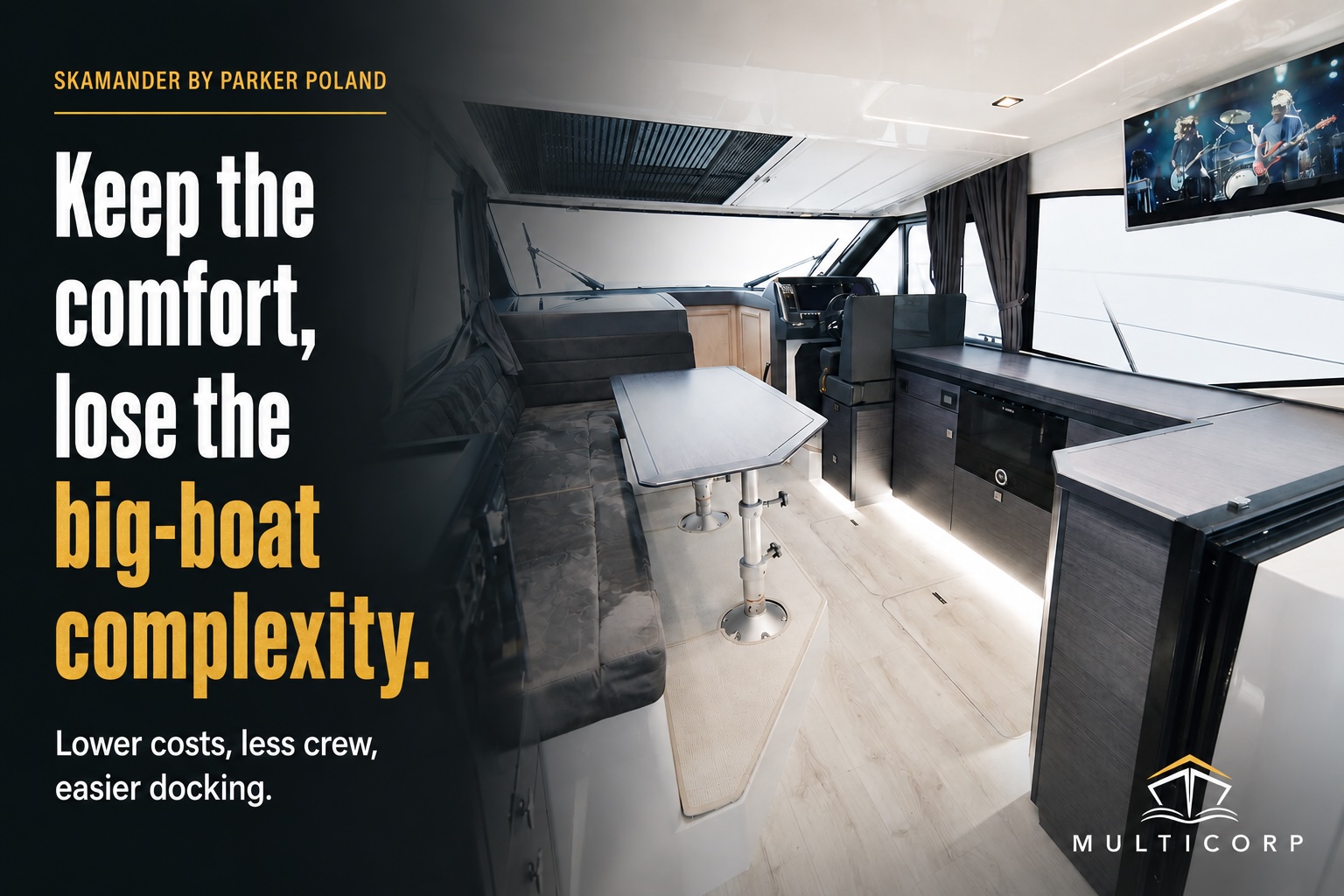
Many yacht owners fear that “downsizing” means giving up the ability to cruise comfortably with family and friends. Well-designed European boats like Skamander by Parker Poland tackle this with intelligent layouts and multi-use spaces.
What you can reasonably expect on a Skamander-class cruiser:
-
Sleeping Arrangements
- Separate forward and mid-cabins (often with double berths).
- Privacy with doors or curtains, not just open layouts.
- Practical storage for weekend or week-long cruising.
-
Galley & Dining
- Fully equipped galley-up or galley-down with cooktop, refrigerator, sink, and storage.
- Dinette that converts from indoor dining to additional berth or lounging area.
- Cockpit wet bar or exterior galley for entertaining.
-
Living & Weather Protection
- Enclosed pilothouse or hardtop models for true three-season Chesapeake Bay boating, Great Lakes shoulder seasons, and shoulder weather in New Jersey, Maryland, and the Mid-Atlantic.
- Large windows and opening hatches for ventilation and sightlines equal to or better than many larger yachts.
- Flexible cockpit with seating that converts from dining to sunpad to fish-ready deck.
You give up some raw interior volume and extra cabins, but gain an efficient, livable layout that’s easier to clean, easier to heat/cool, and better matched to the way most owners actually cruise today.
3. Crew Demands: From “Team Project” to Owner-Operated
Running a 50–70-foot yacht often involves:
- A full-time or part-time captain,
- Professional crew for extensive trips,
- Or at least a very committed family member acting as de facto engineer and deckhand.
Switching to a premium outboard cruiser is, for many, a return to hands-on, owner-operated boating—without the stress.
What changes in day-to-day operations:
-
Manning the Boat
- Skamander boats in the 30–40+ foot range are designed to be comfortably run by one experienced operator with a partner or family member assisting.
- Modern controls (joysticks, bow thrusters, integrated navigation) reduce workload significantly.
-
Roles Onboard
- Less need for someone “living” in the engine room or constantly managing water makers, multiple generators, and complex tank systems.
- More shared time on deck, at the helm, and enjoying the water—exactly what many owners are looking for as they transition from yachting to more flexible boating.
You keep the independence and capability to cruise serious waters—from Chesapeake Bay to Florida or the Great Lakes—but with a platform that doesn’t feel like it always requires a crew to enjoy.
4. Docking & Handling: Confidence in Tight Quarters
One of the biggest psychological shifts when downsizing is realizing how much easier close-quarters handling can become.
Why premium outboard-powered boats can be easier to handle:
-
Joystick & Thruster Integration
- Many Skamander by Parker Poland models offer joystick outboard control and bow thrusters.
- Sideways movement, pivot-in-place maneuvers, and controlled backing into slips become more intuitive—even in wind and current common to Annapolis, Baltimore, and coastal marinas.
-
Lower Windage & Weight
- Compared to a tall, heavy yacht, a well-designed cruiser has less side area for the wind to grab and quicker throttle response.
- This translates to more predictable handling for owners transitioning from larger, heavier platforms.
-
Better Visibility
- Enclosed pilothouse or hardtop boats feature near-360° sightlines.
- Large glass areas and thoughtful helm design allow you to actually see the dock, pilings, and traffic around you—critical in tight Great Lakes harbors, Chesapeake marinas, or busy Florida inlets.
For many former yacht owners, the first season on a Skamander-class boat is defined by something simple but powerful: renewed confidence around the dock.
5. Maintenance Realities: Less Downtime, More Days on the Water
The true cost of a larger yacht is not just fuel and dockage. It’s the time, stress, and delay that come with keeping a complex vessel operational.
By contrast, premium outboard-powered boats are engineered for simpler, more predictable ownership.
Where you’ll likely see the biggest changes:
-
Engines & Drive Systems
- Outboards are standardized, widely supported, and designed for dealer-level service.
- Lower units, props, and common wear items are typically easier to access and replace than components in a deep engine room.
- No shafts, struts, or inboard exhaust systems to maintain.
-
Systems Count
- Fewer duplicated systems (multiple generators, complex hydraulics, extensive stabilization gear) means fewer potential failure points.
- The systems that remain are generally more accessible without tearing apart interior spaces.
-
Service Coordination
- With programs like MultiCorp Marine’s exclusive Command365, qualifying Skamander owners receive year-round service coordination, maintenance guidance, warranty assistance, and dockside support.
- Instead of chasing contractors and yard schedules across the Mid-Atlantic or Great Lakes, you have a partner actively working to minimize downtime.
Premium European brands like Skamander by Parker Poland pair high-quality construction with smart serviceability. The goal is not just fewer breakdowns—it’s an ownership experience that feels manageable, even if you don’t want to be your own full-time engineer.
6. Setting Expectations: What You Gain When You Downsize
When you move from a traditional yacht into a Skamander-class premium outboard platform, you’re not just stepping into a smaller boat. You’re choosing a different style of ownership:
- More spontaneous day trips and weekend escapes.
- Easier trailering or transport options for inland lake seasons.
- Lower fuel consumption and operating costs.
- Simplified systems that still support real cruising and overnighting.
- A boat that’s equally at home on the Chesapeake Bay, Great Lakes, or coastal runs from New Jersey to Florida and Texas.
You’ll sacrifice some sheer scale and perhaps a third or fourth cabin—but in return, you gain independence, flexibility, and a platform that encourages you to use the boat more often.
Considering the Move? Start With an Ownership Conversation
If you’re thinking about downsizing from a yacht to a premium outboard-powered cruiser, the right guidance matters. At MultiCorp Marine, we approach this transition as experienced owners—not salespeople—helping you choose the Skamander by Parker Poland model, configuration, and ownership plan that fit how you really boat.
To explore whether a Skamander-class cruiser is the right next step for your Chesapeake Bay, Great Lakes, coastal, or inland lake adventures, contact MultiCorp Marine for a thoughtful, no-pressure consultation.